Question/Issue:
Using the motion recognition with anomaly detection guide, I created a model that detects gestures if you do them at least two times in a row. However, I’m trying to create a model that can detect a gesture from a single quick motion, and my current model is not accurate enough for that. For example, one rapid counterclockwise rotation on the Z axis should be interpreted as a gesture, and one rapid clockwise rotation on the same axis should be interpreted as a different gesture. Do you have any advice on how to accomplish this?
Project ID:
1105093
Context/Use case:
Gesture recognition in an embedded device
Steps Taken:
- Follow the motion recognition guide
- Attempt to use the model to detect a gesture from a single flick of the device.
Expected Outcome:
The model should be able to detect the gesture from a single flick.
Actual Outcome:
The model is often incorrect until you do the same flick at least twice.
Environment:
-
Platform: nRF52832
-
Build Environment Details: C++
-
OS Version: Linux (NixOS)
-
Edge Impulse Version (Firmware): 1.95.11
-
Edge Impulse CLI Version: NA
-
Project Version: 12
-
Custom Blocks / Impulse Configuration:
- Window size: 2000 ms
- Window increase: 80 ms
Hello @Anthony24851
Thanks for sharing the project you are working on!
Could you please share more details of the dataset that you have? And some of the classes and motions recorded?
I think we can start helping you from there!
Thanks
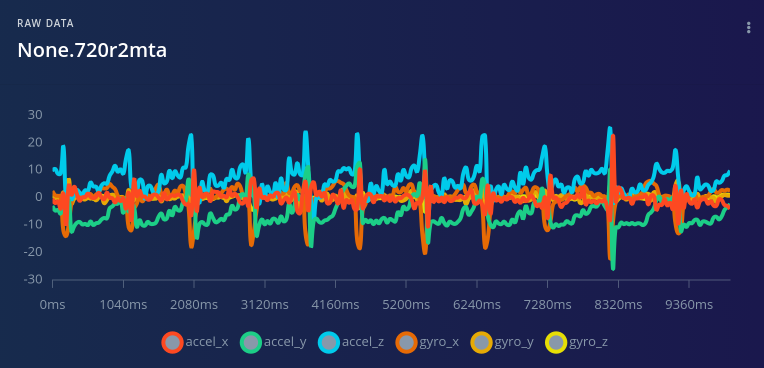
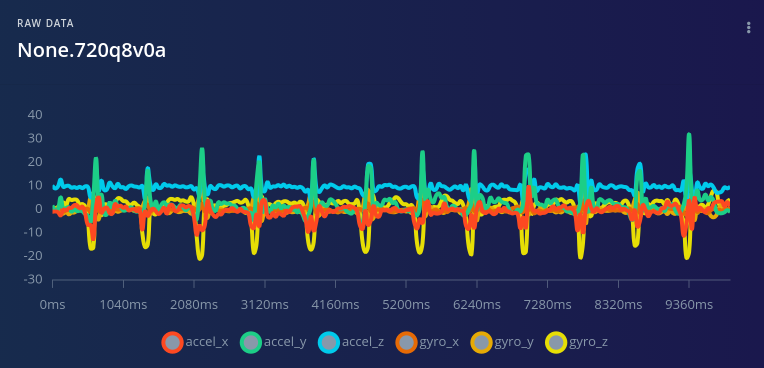
I created the dataset myself by collecting accelerometer and gyroscope data from the device. As directed by the motion recognition guide, I collected about 3 minutes of data for each gesture, with each sample being about 10 seconds long. The data frequency is 50 Hz. I repeated the gesture for the entirety of each sample, as shown here:
And here:
It’s possible that the model requires repeated motions because the window size covers more than one motion in each sample. However, I got very similar results when I decreased the window size from 2 seconds to 1 second.
Most of the gestures I created should be very easy to tell apart because I made fast rotations on different axes. In fact, most of the gestures are named based on which axis I am rotating on. I was hoping the model would have no problem with these basic gestures and I would be able to focus my effort on adding more complicated gestures.
Thanks for your help!
Here is the link to the project so you can see the full dataset.
Hello @Anthony24851 apologizes for the delay replying this message!
Did you solve this in the meantime?
If not, i will explore ideas to help you more 
Hello @marcpous,
Joseph here who is the manager of Anthony. Any ideas are welcome as we need a solution for this issue to adopt the platform.